Accounting Firms

distractions

Dealing With Distractions

distractions

Dealing With Distractions

task virtual assistant

In a perfect world, you would be so focused on your work that nothing could distract you. But our world is not perfect, and it rarely works that way. So why does something so minor as an interruption mess up our entire day?

Distractions can be either external or internal. Some distractions are entirely beyond your control, while others are entirely up to you. What they all have in common, though, is the impact on your day. Let’s look at some of these in detail:

Distraction: Overwhelm
Many accountants feel there’s just too much coming at them all at once, most of it needing to be done yesterday. Add in the constant phone calls and never-ending emails, especially during Income Tax season, that seems to need urgent replies, it’s normal to seek escape. Think of it as reacting in a fight or flight way to a scary stimulus. Running to a distraction in this situation is a flight response to stress.

Distraction Buster
Establish your priorities for the day. With most accounting businesses it’s impossible to avoid phone calls and emails that need to be returned, but you don’t have to answer every phone call or immediately respond to every email. Set aside a specific time of day that you’ll handle those replies.

Then, keep distractions down by sending calls to voicemail and shutting down your email window. If this isn't a viable option for your firm, have your virtual assistant monitor the voicemails and emails, and then flag those that need your immediate attention. All others can wait until your designated time.

Distraction: Doing Everything at Once
Multitasking is a huge distraction, simply because it feels productive when you do it. When you multitask, you get less done than you think. Studies have proven people drop up to 20 IQ points while multitasking. This is because the mind is constantly being distracted by every other task you’re trying to do.

You listen to an eBook while exercising but are mentally making a checklist of what you need to do next. You’re on the phone with one person while checking your calendar to reschedule an appointment with another. You’re answering emails while talking to a team member.

It’s everywhere. In the end? How much of that eBook do you remember? What about that phone conversation? Have you really accomplished anything, or do you now need to go back and double-check your work, or worse, re-do it entirely?

Distraction Buster
When you have no guided focus in your day, it’s hard to keep your attention where you need it most. Schedules set out small goals that let you know when you expect to have those goals completed. Without those guidelines, it’s easy for your day to fall apart as minor distractions sneak in to take up blocks of time not meant for anything.

Create your daily task list the night before, don't wait until that morning when you're running late for an early meeting, or already looking at a full inbox of emails. Then, use your list. Complete a task before starting the next. If new projects come up during the day, add them to the bottom of the list. If they need to be moved up, do it at the end of the day, when you're preparing the next day's task list.

Distraction: Out of Resources
There’s only so much attention you can give to a problem before you run out of gas. How are you supposed to keep plugging away when you're tired, exhausted, and worn out? It’s no wonder you welcome distraction just for the relief it gives from having to think or do another thing.

The truth of the matter is, sometimes we just get tired. Consider this, do you find yourself saying "I forgot to eat", or looking at the clock at night and thinking, "if I fall asleep now, I'll still get a couple of hours of sleep", and if so, how often? If we’re not eating or sleeping properly, our bodies start to show signs of fatigue. It’s impossible to tune out distractions when you’re so worn out you can’t think straight.

Distraction Buster
When you don’t want your day to get away from you, grab your calendar, and put things where you can see them. Look at your task list and schedule your tasks (allowing enough time for each), so nothing gets left out or ignored. When you set out a schedule, you leave less room for distraction. Remember to block out time for things unrelated to your goals, such as sleep or time to eat. You’ll be less likely to skip meals or stay up too late if you have these things already in place on your calendar.

Distraction: Too Much Time Staring at a Screen
Wow, it’s easy to get focused on electronics. When you constantly check your phone, it quickly becomes addictive. Literally! Studies have shown time spent staring at screens releases dopamine into your brain, making a little screen time every bit as effective at giving you a quick ‘buzz’ as a hit on a cigarette.

Before you disagree, think about the last time you left your phone at home. How far did you get before you felt a little twitchy about not having it? If you’re like most people, it’s not just your smartphone grabbing your attention. Between laptops, tablets, and every other iteration of device connecting to the internet, it’s no wonder it’s hard to put the screen down and get something done.

Let’s face it, they’re interesting. Filled with apps, connection to friends and family through social media, the ability to check email…there’s just too much to do, and it’s all right there in your hands. It’s no wonder you’re distracted!

Distraction Buster
Again, schedule your screen time, instead of letting it become a distraction. For example, you can plan your lunch break to be a time to relax and do things that take your mind off work. Most smartphones today have a "Do Not Disturb" setting. I have mine set for nighttime, as well as during the day when I need to be completely focused.

Distraction: You’re on a Treasure Hunt
When it turns out you lack the knowledge to continue, falling into the trap of research distraction is very common. What starts as hunting for an answer to a single question breeds diversion and sends you down rabbit trails that keep you from ever returning to the project if you’re not careful.

How many times did you go to one source, but end up looking at something that wasn't even in your original search? With all the information including social media that you can turn to; you can easily waste hours without even realizing it.

Distraction Buster
First, you need to realize you're getting distracted. The minute you notice that your short foray into something has turned into a distraction, stop right there! If you didn't get the answer within a short time - about 5-10 minutes - then this needs to be added to your schedule for further research. Schedule the time for it and make the conscious choice to focus on something else now.

Distraction: What If or How About?
Are you full of ideas? While this is a good thing on many levels, thoughts can also lead to distractions, especially when you start coupling ideas with action.

Moving from one idea to the next, from one project to the next, can feel efficient…at first. In truth, you’re getting less done than you think. Imagine a job involving the remodeling of a house. Say you need to update the kitchen, want to renovate the bathroom, are building a front porch, and painting the dining room. You might think you’re being efficient if you’re doing all projects at the same time. After all, that means you’ll be done at once and have a great house to live in…right? Now imagine finding other home repair jobs as you go and adding to the chaos until the whole place is a mess.

Having too many ideas is very similar. You’re throwing time at first this, and then the next without ever completing anything. You’re adding new things in. In the end, you’re so distracted by so many things to do, that you’ve lost the ability to prioritize, and nothing gets done at all.

Distraction Buster
Keep a notepad nearby so that you can write down ideas that hit you throughout the day and give yourself permission to come back to them later.

Distraction: You’re Trying to Save the World
If a team member is having difficulty working through a return and comes to you for help, do you end up doing their work as well as your own?

If you continuously involve yourself in other people’s problems, it’s hard to get your own projects completed. This ‘save the world’ mentality means distraction comes in the form of altruism, which looks pretty on the outside. Nobel, even. On the inside, though, is the stark truth that you’re distracting yourself under the guise of doing a favor for someone else.

Distraction Buster
While it’s great to want to help and lend a hand now and again, you need to ask yourself if this opportunity is just another distraction? If so, is it one you can afford? Next time, ask the team member to offer you possible solutions to their problem rather than just handing it off to you.

Distraction: You’re Getting Organized
Simply put, you’re not getting anything accomplished, and now you're caught up in the spiral of trying to throw yourself into a new system to fix everything. Organization is another one of those distractions that looks helpful initially. After all, every self-help course is going to recommend cleaning your workspace to make it ‘work better for you.’

The truth of the matter is this kind of organizing can take on a life of its own very quickly. What might start as a quick tidying up suddenly devolves into color-coded notepads, a series of highlighters, and a complex system of calendars. Because it feels like progress, you don’t see it as a distraction. It becomes one when you’re losing out on serious work time as you keep poking at the ‘system’ to make it work.

Distraction Buster
Ask yourself, are you spending more time working on your projects or talking about working on your projects? Handoff the organization to your virtual assistant. Work together to come up with the best tools for your firm, then let your VA set it up and put it into motion.

As you can see, distractions are honestly everywhere, surfacing for a variety of reasons, with a lot of baggage behind them needing to be dealt with if you’re ever going to move forward. You are the master of your fate. It’s up to you to tune out the world and put your focus where it matters most. You really do have the ability to control the situation, whether it’s stamping out the distractions before they gain a foothold, or knowing how to put yourself back on track when the distractions find you.

No matter what, don’t expect easy answers. Nothing here is going to happen overnight. It takes time to build new habits and a new way of thinking. If you fail, simply try again. Give the process time. It will happen.

Dealing With Distractions Read More »

productive people

How Productive People Think

productive people

How Productive People Think

task virtual assistant

Productivity is not just about working hard or being busy. It's about being effective with your time and resources. Productive people are able to focus on what's important and make sure that they are using their time wisely.

A productive person is someone who has the ability to make their own decisions and take action on them. They are able to prioritize tasks, manage time, and set goals for themselves.

So how do productive people think?

Priorities matter

People who are the most productive are clear about their priorities.  They know that some things are more important than others and they’re able to attack the most important things first.

Start each day by making a list of tasks and placing them in order of priority.  This will help you to get the most important things done first and even help you to eliminate tasks that really aren’t necessary.

Understanding priorities also makes it easy to delegate tasks and avoid things that might take away from reaching goals.

Plan for success

Productive people make a plan.  They schedule their next day at the end of the current workday.  This makes it easy to jump right into work the next day without having to take time to decide what’s next on the list.

Eliminate time wasters

There are many things throughout the day that could threaten to take away from productivity.  Productive people know how to put those time-wasters on the back burner and stick to the important work.

It could be social media, chatty coworkers, emails, text messages, phone calls, or reading online news that prevents you from getting business done.  Set those things aside and schedule a specific time when you will allow yourself to participate in those things.

Take responsibility

Productive people are happy to take responsibility for both their successes and their failures.  Rather than looking to point the finger at someone else, they stay accountable for their work.

Learn from mistakes

Productive people have a healthy attitude toward failure and are able to use it as an opportunity for growth. They are not afraid of making mistakes and they learn from them.

The key is to take the time and think about why you failed so that you can learn from your mistakes instead of letting mistakes throw you off course or cause you to quit.

Efficient tools

Productive people also know it’s important to have the right tools to do the job.  That means having a high-quality computer, the proper software, and even the right desk setup.  When you have what you need in your workspace, it helps you to get more done.

If you want to become more productive, it helps to understand how productive people think.  Think about your own productivity levels.  Where can you make changes in your mindset to become more productive?  Small changes can lead to big results.

How Productive People Think Read More »

time management

5 Tips To Stay Ahead Of The Curve

time management

5 Tips to Stay Ahead of the Curve

virtual assistant

Running an accounting firm is not easy, and oftentimes, not the most exciting. There are so many mundane, everyday tasks necessary to keep the business running. Tasks such as filing, billing, and data entry bog down a daily task list; they have to be done, but not by you! Hiring a virtual assistant can be a simple solution. But how do you know when to outsource? These five tips will keep you ahead of the curve by helping you sort through your tasks and decide what you can do and what you could be letting someone else do.

1. Set S.M.A.R.T Goals

Have you looked at where your firm is, and where you want it to be? Do you have a clear road map to get there? Many times, we fail to reach our goals because we haven’t defined them clearly. It’s simply not enough to say, “I want to make more money this year,” or “I’d like to spend more time with my family.” Your goals need to be very specific. They should provide direction, and motivation, and clarify the importance of what you’re aiming for. Setting up SMART goals that are Specific, Measurable, Achievable, Realistic, and Timely is a recipe for success! So, instead of "I want to make more money this year", say, "I will increase sales 17% by end of Q4".

image-3

2. Know Your Why

Once you settle on a goal and a specific target, you need to clarify the purpose of the goal, or ‘your why’ If your goal, for example, is to increase earnings over last year, determine WHY you need more money. Do you want to take on more clients, or maybe you want to staff the office?


The ‘why’ is more important than the ‘what’.  Your ‘why’ is the foundation, the passion driving you. If you lose sight of why you have settled on your goal, it will be much more difficult to stay motivated.

3. Work Smarter Not Harder!

Building a successful accounting firm isn’t easy. Many accountants burn out within the first 5 years. They lose the passion and the drive that is necessary to stay competitive, especially if they are too busy working 70+ hours a week. Believe it or not, there is proven research behind the 40-hour workweek. It wasn’t designed to help workers, but to boost productivity, which has been shown to drop dramatically after working more than 40 hours per week for a month. Being busy is not the same as being productive.


time management

Let me say that again - Being busy is not the same as being productive.  Top performers focus on the activities that support their goals. They leverage technology and other services to help them be more productive.

4. Create A Daily Task CheckList

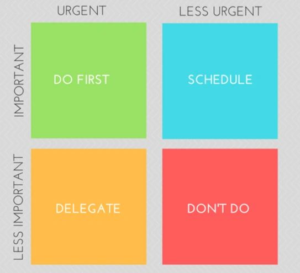
If I were asked which one of the five tips I'm providing is the most important, it would be this one. A task checklist is a visual tool of accountability.  Start the first 10 minutes of your day by writing down all the things you need to accomplish. Ask yourself: which activities generate the most income? Begin prioritizing your most income-producing tasks first using the Eisenhower matrix:

time management

1. Do First

Tasks in the green box should be the core tasks that directly earn you money such as responding to new leads and current clients.

2. Schedule

Important, but not urgent tasks belong in the blue box.  Schedule tasks like continuing education, reading the latest IRS updates and researching virtual assistants.

3. Delegate

The yellow box should be reserved for less important tasks, but need to be done rather quickly. These are tasks that do not necessarily have to be done by you. These tasks can and should be, delegated to someone else. Hiring a Virtual Assistant is a great way to delegate tasks.

4. Don’t do

The red box is for STOP. These are the tasks that aren’t helping you at all. For most people, these will be time-wasters such as spending time on social media related. For example, have you been spending an hour a day on Facebook with nothing to show for it? Probably time for a new strategy. These tasks should definitely be turned over to a Virtual Assistant.

Prioritizing your daily tasks will make you that much more productive and mindful of how you spend your time. By using a Task Checklist daily, you’ll start to recognize patterns in your routine and find solutions to improve your results.

5. Hire a Virtual Assistant


No one person can do it all. Delegate or outsource everything except the stuff you’re good at because it allows you to focus on the tasks that you’re amazing at, like analyzing the numbers!

Virtual AssistantLook back on your daily task checklist; how many of the tasks are not high priority or goal-oriented but need to get done? How many of those tasks can you delegate to your VA - social media accounts, monthly mailings, engagement letters, and administrative tasks?

A virtual assistant is your customizable asset!

5 Tips To Stay Ahead Of The Curve Read More »